
Part 6 of The Season We Built, a series on how November and December came to be the way they are.
I am not a true-blue, diehard Black Friday shopper. To be honest, I had more fun Christmas shopping when I was a kid than I do now.
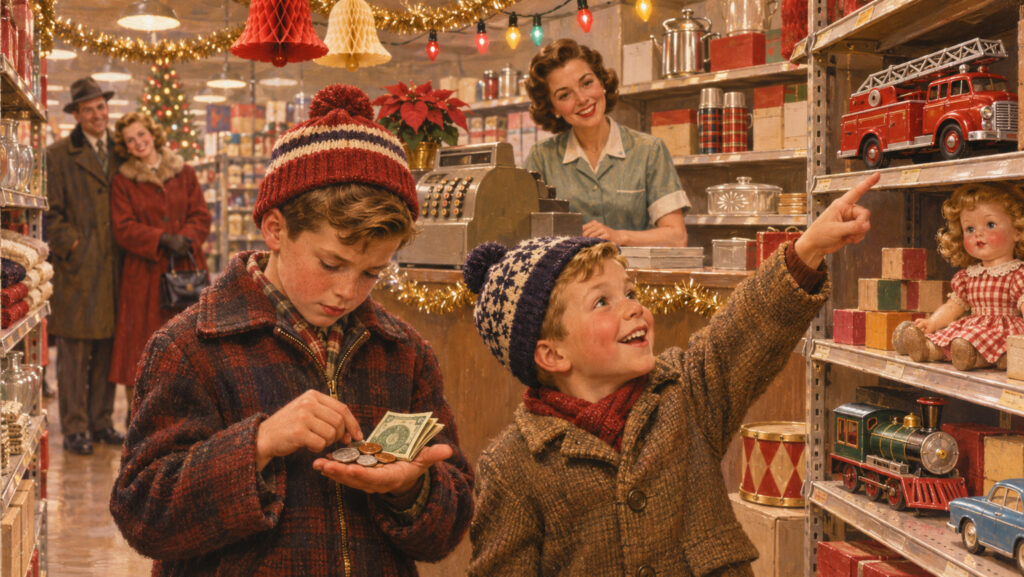
Starting each January, Mom took my brother and me to the Marshall County Building and Loan once a week. Each of us deposited twenty-five cents into our Christmas Club savings. By December I had $12.50, and it was mine to spend on presents for the family.
Then came the trip to Kmart on the south side of South Bend. Mom and Dad turned us loose to wander the aisles and find our gifts. Twelve dollars and fifty cents, a year in the making, and a whole store to spend it in.
It was a different time.
Before Black Friday was Black Friday
Back then the stores were closed on Thanksgiving, and there was no Black Friday as we know it. The name itself was police slang in Philadelphia in the early 1960s, a complaint about the traffic and crowds on the day after Thanksgiving. It took years for the rest of the country to pick it up, and longer still for it to become the event it is today.
When I was growing up, everything about Thanksgiving was about Thanksgiving. Christmas came afterward. That is less true every year. Signs of Christmas show up well before the turkey does. The trees are up in many homes. Secret Santa names have already been drawn. Thanksgiving has become a prelude to Christmas.
None of this fell from the sky. People decided it, a little at a time. Someone decided when the sales would start. Someone decided the doors would open on Thanksgiving itself, and for a number of years they did. Then the biggest chains decided to close on Thanksgiving again, and most are closed again this year. A tradition that a company can open and close with a memo was never handed down from on high. We built it, and we keep rebuilding it.
Who works on Black Friday while we shop
The big stores may be dark on Thursday now, but the work did not disappear. It moved. It moved to the restaurants where families eat out, to the groceries and pharmacies open for whatever we forgot, to the warehouses and delivery trucks behind every online order, and to the early hours of Friday morning, when someone has to unlock the doors.
People work because people shop, or eat out, or do any number of things that have become part of the day. Earlier in this series I wrote about who works the holidays and what it costs them. I want to add something here, because there is a mistake that well-meaning people make.
We should not pity everyone who works a holiday. Many of them want to be there. The day pays extra, or it pays overtime, and that money matters to a household in December. Not everyone on the schedule chose it, and some had no say at all. Pity is a poor gift either way. It lets us feel tender for a moment and changes nothing about how we treat the person in front of us.
Thank them like you mean it
What I suggest instead is simple. Thank them, and let the thanks cost you something.
Extra courtesy, to begin with. Patience in the long line. A kind word at the register. And for wait staff, big tips. I mean big, big tips. They are being generous with their time on a day the rest of us guard for ourselves. We can be generous in return.
Being honest about Black Friday and the season it opens
Shopping is only one of the ways the holidays have changed. Many of us now understand that the Thanksgiving we learned about in school is a myth. More of us are also coming to realize that some of our neighbors, people of other religions and people of none, have Christmas in their faces for at least two months of every year. For some, Christmas is a religious holiday. For others, it is a secular event that has nothing to do with the baby Jesus. And every year the politics of Christmas come out, and “Merry Christmas” is turned into a weapon against those who choose to say “Happy Holidays.” I will come back to that before this series ends.
I am not suggesting that we give up the holidays. I am saying that we should be honest about what it is we are celebrating, understand the symbols we use, and recognize that what we say and do affects a great many people.
“This is tradition, and this is America” is not much of a defense. It has little to do with the traditional meanings of the holidays. It turns the traditions into weapons while showing little compassion for the people on the other end of them.
A boy with $12.50 and a whole store to wander did not know any of this. The man he became does. So this weekend I am asking myself one question, and I pass it along to you.
Who served you this weekend, and how did you thank them?
