A self is not given. It emerges.
Essays and reflections on how we become who we are.
Read the articles
What if dignity is not something we are born with?
Humiliation, recognition, and the making of worth.
Read the articles
Leaving can be its own kind of arriving.
Belief, doubt, and what remains.
Visit the blog
Grief changes us. It need not end us.
Loss, endurance, and meaning.
Read the articles
Every disagreement holds more than two paths.
Thoughtful responses are always welcome.
Join the conversation

Welcome

The Emergent Self is a place to think carefully about how we become who we are — through humiliation and recognition, belief and doubt, loss and meaning. I’m Robert K. Green, a writer and scholar who has spent a lifetime questioning what we’re told it means to be human. Read, disagree thoughtfully, and join the conversation.

More about me →

Latest articles

Illustration of the systems we build: many hands of different skin tones assembling an open scaffold in sage green, pink and blue, with people inside it and others watching from its edges.

The Systems We Build, and the People They Make of Us

People build systems, and then those systems quietly build us. What the research on corporate leaders reveals about privilege, who pays the price, and why what we built we can also rebuild.
A luminous figure dissolving into flowing fabric and light in golds and warm tones, suggesting human transformation and becoming

People Are Verbs: The Quiet Rebellion Against How We’ve Been Taught to See Ourselves

What if you are not a thing at all, but a happening? Whitehead's quiet rebellion against the grammar of nouns — and the freedom it offers.
Open doors of a grand Catholic church, seen from the altar with a green chasuble in the foreground, looking out on a neighborhood street where neighbors talk together

From the Altar to the Streets

I loved the liturgy and served a near-northside Indianapolis parish as White flight hollowed it out. Spinoza helped me understand why I had to leave, and what true piety asks of us.

From the blog

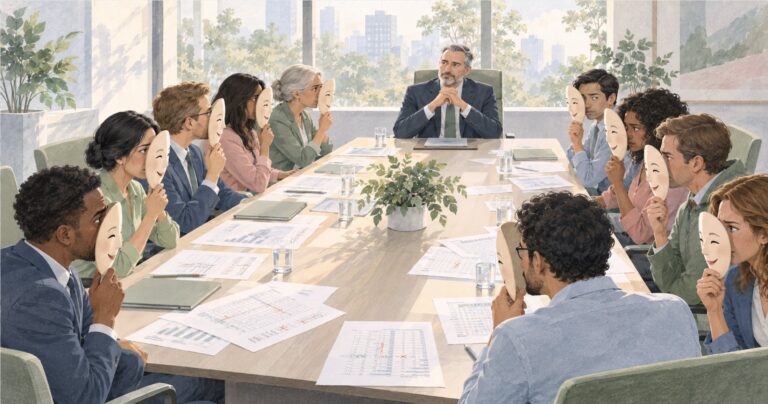
Why flatterers turn on you: an illustration of a conference table where employees hold smiling masks in front of wary faces as they turn toward the boss at the head of the table.

Why Flatterers Turn on You

The person who flatters you most may be the one most likely to turn on you. A meeting I came to dread, the research behind it, and why the truth people can’t tell you goes somewhere else.
An older White woman in a Sunday coat and hat stands in a sunlit church, seen from behind, looking up at a large Haitian-style creation tapestry of Black figures, animals and a golden sun

A God You Can Keep in a ZIP Code

A parishioner once told me a tapestry did not belong in church because there were no White people in it. Thirty years later I have the words for what she was defending: not God, but a mascot.
Watercolor of a man seen from behind on a bench in a dim office break room, a second coffee cup set beside him as dawn light comes through the window, asking whether depression was really a gift

Was My Depression Really a Gift?

Was my depression really a gift? A former priest tests his own claim that the dark years after he left the priesthood were a gift.

New writing, delivered quietly

Receive new articles and blog posts by email. No noise, no selling — just the writing.