
Part 2 of The Season We Built, a series on how November and December came to be the way they are. Part 1 is here.
The year it snowed all day
The year my father was laid off from Bendix, it snowed all day on Christmas Eve.
We lived on 8th Road, west of Donaldson, in a stretch of rural Indiana where several of the neighbors were Italian families who had come down from Chicago. I didn’t know we were poor. I knew that Dad had cut a tree somewhere and dragged it home, that Mom had decorated it until the parlor looked like a place where something could happen, and that there were no presents under it. I knew my grandparents had driven in from Elmhurst that morning. And I knew, with the certainty only a small boy has, that this was the year I would meet Santa Claus.
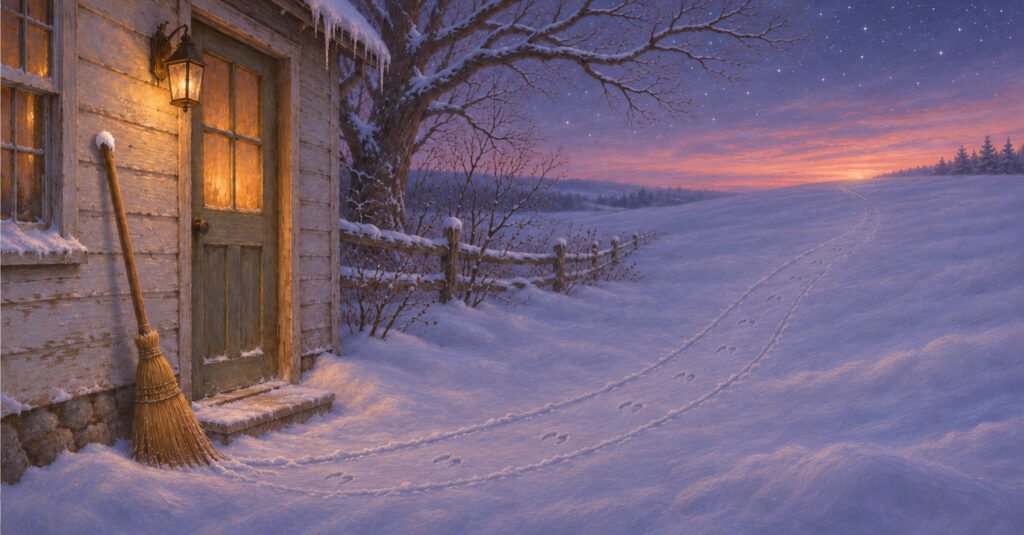
After supper, Dad took my brother and me down the road to the Giarapputos’ for coffee. I have never waited through anything as slowly as I waited through that coffee. When we finally pulled back into our driveway, my mother and grandparents were at the front door waving us in, hurry, hurry. We ran past the tree, past gifts that had appeared from nowhere, through the kitchen, and out the back door that Grandpa was holding open. He pointed at the sky. Santa had just lifted off. He pointed at the ground. There in the deep snow were the sleigh tracks and the reindeer prints. I waved at the sky until he was gone.
Then we went back inside to an electric train running around a track and a floor covered with more toys than our house had ever held.
Years later I learned that while we were drinking coffee a quarter mile away, my grandfather had gone out in the snow with a broomstick and our German Shepherd, Champ, and made the tracks himself.
I have thought about that night for most of my life, and here is what I have come to. The most magical Christmas I ever had was built, by hand, by a man who loved me, out of a broom handle and a dog. Knowing that has never cost me a thing. If anything, I love the night more. And that, in one back yard, is what this series is about. The holidays are not weather. Somebody made them. The question is who, and for whom.
The invention of Christmas: a short, surprising history
Start with this: for a long stretch of American history, Christmas was against the law.
The Puritans who ran Massachusetts Bay banned it outright in 1659 and fined anyone caught celebrating. They had their reasons. Nothing in scripture named December 25, the date had been borrowed from Roman midwinter festivals, and the way ordinary people kept the day had little to do with piety and a great deal to do with drink. Christmas in old England and early America was a rowdy public holiday, closer to Mardi Gras than to a silent night. Bands of young men and the poor went door to door demanding food, drink, and money from the well-off, and the well-off were expected to hand it over. It was the one season when the social order turned briefly upside down.
So the holiday I ran through my grandparents’ arms to reach, the one with the quiet tree in the parlor and the gifts for the children, was not ancient. Historians who have traced it, Stephen Nissenbaum most carefully in The Battle for Christmas, put its birth in New York in the first few decades of the 1800s. A small circle of well-to-do New Yorkers, worried about the drunken crowds in their streets at year’s end, went looking for a gentler holiday and more or less assembled one. Washington Irving wrote nostalgic sketches of an old English Christmas that had never quite existed. John Pintard revived a forgotten Dutch saint, Nicholas, as the city’s patron. And in 1823 a poem appeared in a Troy, New York newspaper that gave the saint a sleigh, eight reindeer, a sack of toys, and a habit of coming down the chimney while the children slept.
Within a generation, the holiday had moved indoors. It left the street and entered the parlor. It stopped being about the poor demanding their due from the rich and became about parents giving to children. It stopped being about adults and became about the kids. The tree came from Germany by way of immigrants and a famous engraving of Queen Victoria’s family. Dickens supplied the conscience in 1843. Congress made the day a federal holiday in 1870. By the time my grandfather went out in the snow with his broomstick, the whole apparatus was in place and looked as old as the hills.
Why the holiday moved indoors, and whose problem that solved
I want to pause on one word in that history: worried. The men who built the domestic Christmas were not simply sentimental. They were respectable people in a growing city who did not care for crowds of working men banging on their doors in the dark. A holiday centered on the family hearth, on children, on gifts flowing downward from parent to child rather than sideways from rich to poor, was a holiday that got the crowd off the street. The merchants, as Leigh Eric Schmidt shows in Consumer Rites, were not far behind.
I don’t say this to make villains of them. I say it because it is the pattern every piece in this series will return to. A tradition that feels like it belongs to everyone was shaped by particular people with particular problems, and it solved their problems first. The rest of us inherited the solution and called it Christmas.
Thanksgiving has the same kind of story, and I’ll tell it in two weeks. For now, one detail: the national Thanksgiving we keep on the fourth Thursday of November exists because a magazine editor named Sarah Josepha Hale campaigned for it for seventeen years, because Lincoln needed something to unite a country at war in 1863, and because in 1939 Franklin Roosevelt moved it a week earlier to lengthen the Christmas shopping season. The merchants asked. The president obliged. Congress settled the date in 1941. That is how a sacred national ritual gets its date: a lobbying campaign and a retail calendar.
The calendar is a tool, and somebody is holding it
Here is where the history stops being a curiosity and starts to matter.
Once you see that the season was assembled, you can ask who gets to set the schedule. School lets out for two weeks in December; it does not let out for Diwali or Eid or Rosh Hashanah. Businesses close on December 25 and expect everyone, of whatever faith or none, to use the day as the culture intends. The fiscal year, the retail year, the church year, and the school year all bend around the same six weeks, and the bending feels natural because we have never known anything else. But a calendar is not a law of nature. It is a decision about whose rhythms count, made by people with the power to make it stick, and then handed to everyone else as simply the way things are.
That is the quiet power of a built thing that passes for weather. Nobody has to defend it, because nobody thinks to question it. It is also why the people outside the calendar, the ones whose holy days fall on ordinary Tuesdays, whose jobs do not stop on the 25th, whose families do not look like the one in the parlor, feel a pressure they cannot quite name. Nobody is forcing them to do anything. The schedule simply assumes they aren’t there.
After the invention of Christmas: a built thing can be rebuilt
I’ll end where I began, in the snow behind the house on 8th Road.
My grandfather did not discover Santa’s tracks. He made them. And the magic I felt was not in the tracks; it was in what I made of them, with the whole of a small boy’s longing. The experience was a broom handle dragged through the snow. The interpretation was everything.
That is the freedom hidden inside this history. If the season were weather, we could only endure it. Because it was built, we can look at the parts, decide which ones we are keeping, and put the rest down. I am keeping the tree in the parlor and the snow on Christmas Eve and a grandfather who would go out in the cold to make a child’s dream come true. I can keep all of that while knowing exactly where it came from, and while asking, over the next several weeks, who paid for the rest of it.
Which piece of your holiday would you keep if you learned tomorrow that a department store invented it? Tell me in the comments. I’d like to know what’s under your tree.
