
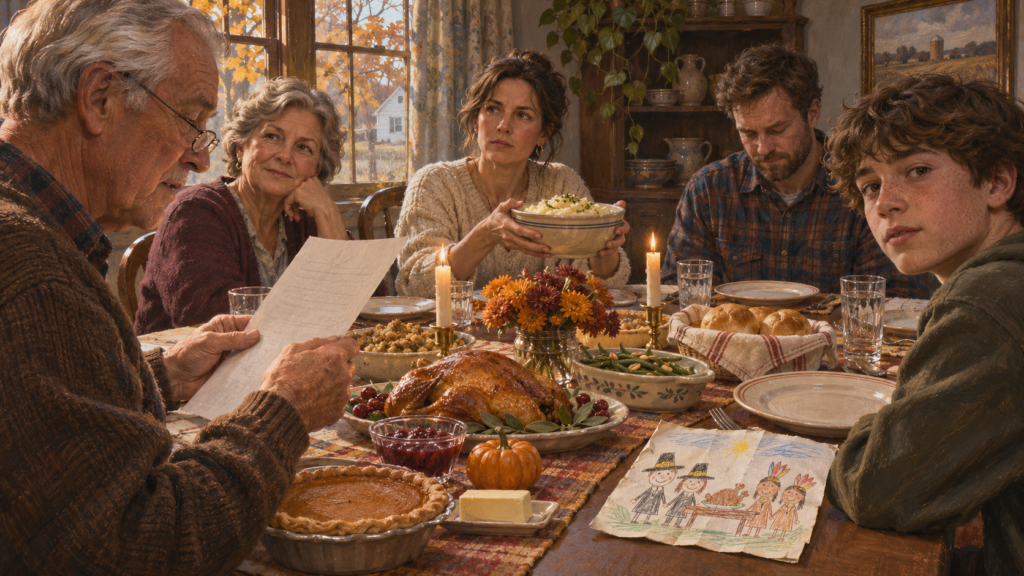
Part 5 of The Season We Built · A reading for the Thanksgiving table
I wrote this piece to be read aloud at the Thanksgiving table, once everyone has gathered and before the meal begins. If you’re the one reading it this year, my invitation is simple. Take a few minutes with the people you love to consider the story many of us learned as children, whose voices we heard in the telling, and whose words we might carry home with us this time.
Before we pass the food, could I ask a question?
Think about the picture of the “first Thanksgiving” most of us grew up with—the one from schoolbooks and classroom wall cutouts. At that table, who was hosting whom?
For a long time, I pictured it as our story. The Pilgrims set the table; the Wampanoag joined them. It took me years to notice how easily I could put myself in the Pilgrims’ shoes without knowing a single name of the people across from them—and even longer to ask how newcomers became the hosts on someone else’s homeland.
When I say we in this piece, I am speaking from the side of the White Europeans who arrived as invaders, and of the Americans who inherited their version of the story. That is the history I am answering for. Every person at this table carries their own family story, too.
We told a simplified story about Columbus the same way. Kids learned to say he “discovered” America in 1492—get the gold star, move on—without ever asking how those ships looked to the people who had lived on that land for thousands of years. How did those ships look to them as they stood on the shore? On that very first voyage, when they landed, Columbus took people by force. He wrote it down himself. Millions of kids learned his name. Almost none learned the name of a single person that Columbus and his men seized.
Our Thanksgiving story was built out of the same kind of selective memory. We had a voyage. We had a harvest meal. Then we added the meaning we wanted our children to inherit.
Start with the corn. In 1620, before the harvest we picture today, English explorers on Cape Cod found corn that Native people had stored away for winter. What did they do with the corn? They took it. Their own journals say they meant to pay the owners back later. Bradford later wrote that they paid the owners about six months afterward. The families had no say when the corn was taken. The invaders’ journals further noted that the people who owned the corn had run off in fear of the English. Someone planted that corn. Someone tended it, brought it in, and stored it away for use in the cold winter months. It is easy for me to picture a hungry sailor, and that saddens me. But it hurts me more to realize how rarely our Thanksgiving story has asked us to picture the Native families, who put their corn away for the lean months, coming back and finding their corn supplies gone.
Next, let us look at the deer. In the autumn of 1621, the Wampanoag leader Ousamequin arrived at the English settlement with around ninety Native men. The gathering lasted three days. Colonist Edward Winslow, who was there, wrote that the Wampanoag men hunted five deer and brought them to the English.
Five deer. Think about what it takes to feed a crowd for three days—and think about what we did with that generosity. We turned a diplomatic gesture and a shared meal into a story where Indigenous people existed mainly to welcome us. Sharing food with neighbors is one thing. Treating their hospitality as permission to take their country is quite another, but that is exactly what we did.
What happened next wasn’t a footnote; it was the rest of the history. Over the coming decades, English colonists took more and more land. They murdered Native families in order to obtain more and more land. Eventually, war broke out. In these massacres, Wampanoag families lost their homes and loved ones. The White invaders captured Native people and sold them into slavery. Those purposely forgotten chapters belong to Plymouth just as much as the autumn harvest does. They belong to us, too, as we sit at this table celebrating Thanksgiving. Yet the annual Thanksgiving school play always ends at the dinner table, with everyone smiling and nothing unresolved. It simply adds to the myth that we celebrate around this table.
Even the label “first Thanksgiving” came later. More than two hundred years after that gathering, in 1841, an editor named Alexander Young added a footnote to Winslow’s letter calling it “the first Thanksgiving.” Later, in 1863, in the middle of the Civil War, Abraham Lincoln proclaimed a national day of Thanksgiving. Doing so was a strategic political move to ease the suffering of a divided country. Over time, textbooks, paintings, and holidays braided the Plymouth meal and November together until a nineteenth-century editor’s note felt like an eyewitness memory.
And when a Wampanoag speaker tried to share what his own people remembered, we can see how uncomfortable that truth was. It’s the same annoyance and discomfort that is probably present at this table with this reading.
In 1970, organizers in Massachusetts invited Wamsutta Frank James—an Aquinnah Wampanoag man—to speak at a banquet marking 350 years since the Pilgrims landed. When they reviewed his draft beforehand, they objected. He had written honestly about ancestral graves being disturbed, provisions being taken, land being lost, and his pride as a Wampanoag. They told him he couldn’t give that speech and offered one written for him instead. He refused. That Thanksgiving, he and others gathered in Plymouth for the first National Day of Mourning.
One line from his prepared remarks deserves a seat at our table now. James wrote that “we the Wampanoags still walk the lands of Massachusetts.” In 1970, those words challenged people who thought of Native Americans only as figures from a past painting. Today, they are right in front of us if we choose to listen.
I feel a real weight knowing we once asked a man to honor our ancestors on the condition that he silence his own. At the same time, I recognize the instinct behind that demand. People want the meal to feel warm. They want everyone to leave in good spirits. I feel that tug myself whenever I decide what to say before a meal with people I love—it would be far easier to offer a quick blessing, pass the potatoes, and leave it there.
I am deeply grateful for this food. I am grateful for the hands that cooked it and for every face across this table. I hope we share many more meals like this one.
And because I care about the young people at this table who will carry our family stories forward, I want to give them a true answer when they ask what happened.
There was a harvest. Wampanoag hunters brought five deer. Colonists took land, and Native families paid the price. And when a Wampanoag man wrote down what that history meant to him, he gave us words worth keeping.
After dinner, I’d love for us to read what he wrote together. Today, he gets the last word.
