
Part 4 of The Season We Built, a series on how November and December came to be the way they are.
There is nothing wrong with giving someone a turkey.
A family needs food. Someone provides it. An immediate need is met, and that matters.
But the family will need to eat again after Thanksgiving. There will be breakfast on Friday, dinner the following Tuesday, and an ordinary afternoon in March when the refrigerator is empty and nobody is organizing a holiday collection.
I keep thinking about that afternoon.
What would it take for a community to make feeding one another part of its ordinary life? What could we build together that would still be there when the seasonal generosity had passed?
One person can buy groceries for another household. They may be able to do it several times. Most people cannot sustain that responsibility indefinitely. They have their own expenses, obligations, health concerns, and limits. Even someone with money may lack the time, facilities, or knowledge to organize dependable meals for others.
A church can bring more people and resources together. It might prepare a holiday dinner, collect food, or organize deliveries. Some congregations already sustain food programs throughout the year. Others can manage only occasional efforts, often through the work of a small group whose names appear on every volunteer list.
The intentions may be excellent. The difficulty is sustaining all the work.
Someone has to obtain the food. Someone needs to prepare it, transport it, serve it, clean up, recruit people, manage money, and make sure there will be enough of everything next week.
We ask a great deal when we expect one person—or one organization—to carry the whole undertaking.
Perhaps the question is how to organize the undertaking differently.
What one ant cannot do
An individual worker ant can search for food, carry material, tend young, or contribute to maintaining a nest. Its activities depend on its species and circumstances. Its capacity is limited.
Across a colony, however, different ants perform different tasks. Their interactions help coordinate work and adjust activity to changing conditions. The queen does not sit at the center issuing instructions to every worker. Much of the organization arises through the ants responding to one another and to what is happening around them, as Arizona State University’s Ask A Biologist explains.
The colony can accomplish things no individual ant could accomplish alone.
That is the aspect of emergence that interests me here. Through relationships among the parts, a capacity develops at the level of the whole.
We often discuss the emergent self in terms of a person’s becoming: how bodily experience, interpretation, relationships, and surroundings participate in the formation of a life. But emergence need not stop at the boundary of an individual person.
A community can also develop new capacities through the way its members relate and work together.
The ant comparison has limits. People have rights, conflicting commitments, and reasons to question a shared purpose. We should want them to keep that freedom. A community organized around feeding people must have room for disagreement about how it does so.
What we can borrow is the possibility of coordinated work: different contributions becoming part of something dependable.
Imagine a café
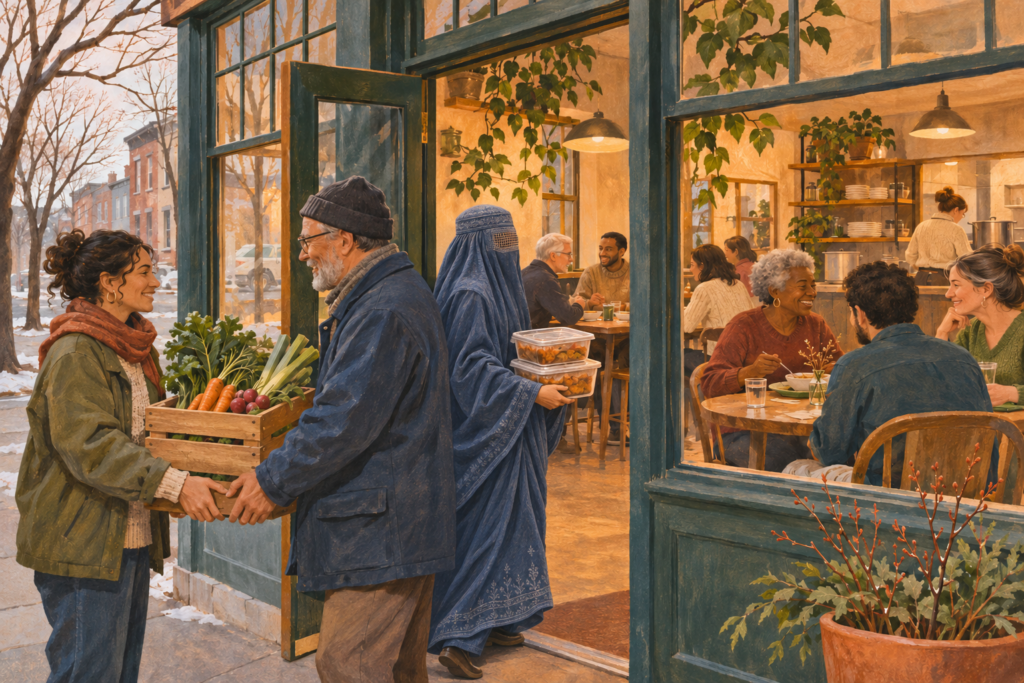
Imagine a café in your neighborhood.
There are tables, comfortable chairs, and people deciding where they would like to sit. Someone arrives alone. A parent comes with children. Two neighbors meet for lunch. A person who has had a difficult morning finds a quiet place to eat.
There is some choice about the meal. People can ask about ingredients. They can say that something does not suit them. Nobody has to provide a public account of their hardship before being welcomed.
Some customers can pay the full cost. Some can contribute a little. Some cannot pay that day. The arrangements allow them to eat without turning the dining room into a visible division between benefactors and beneficiaries.
This is not an entirely imaginary possibility. One World Everybody Eats supports a network of community cafés using a pay-what-you-can model to address food insecurity and build community. That existing work gives us something to learn from rather than requiring every neighborhood to begin from nothing.
What I want to consider is the network of relationships that could make such a place dependable.
The café would be where people eat. It would not have to be the organization that does everything.
Different groups, connected work
One congregation might have a suitable kitchen and people experienced in preparing meals. Another might have volunteers who can organize transport. A neighborhood organization might know how to recruit and schedule people without repeatedly exhausting the same few.
A local business could contribute regular funding. People with purchasing experience could help establish reliable food supplies. Others could organize cleaning, maintain equipment, manage accounts, or arrange deliveries for people who cannot reach the café.
Those responsibilities would need to fit actual abilities and resources. Having a room does not necessarily mean having a safe, suitable kitchen. Having willing volunteers does not mean having enough people to fill every shift. The work would require honest assessment, training, and funding, including paid coordination where needed.
But no group would have to pretend it could do everything.
Each would undertake a defined part of the work, knowing how that contribution connected with the others. If a group could no longer meet its commitment, there would be a way to report the difficulty and arrange support.
A transport team’s work would matter because food prepared elsewhere could reach the café. The kitchen’s work would matter because supplies arrived when needed. The dining room could welcome people because someone had taken responsibility for cleaning, staffing, and keeping the doors open.
Over time, people could come to count on the whole arrangement.
The meal would be the visible result of many relationships functioning together.
Whose name is on the door?
There would be another kind of work to do.
Organizations have identities. They have histories, loyalties, donors, and ways of explaining their purpose. People have invested years in them. Those attachments can sustain extraordinary effort.
They can also make cooperation difficult.
Whose project would this be? Which organization would receive the credit? Whose procedures would govern? Would one congregation participate only if its name appeared prominently? Would a community group hesitate because it feared becoming an accessory to someone else’s mission?
These are human questions. Wishing away ego will not answer them.
We would need arrangements that made sharing responsibility possible without requiring every participant to surrender its identity. Churches would remain churches. Civic organizations would retain their commitments. Individuals could participate without adopting the beliefs of another group.
But feeding people would have to take precedence over making the café a recruiting opportunity, a publicity exercise, or a monument to one organization’s generosity.
Recognition could be shared. Decisions could be open to scrutiny. Leadership could be accountable.
The question at the center would be whether people could count on eating, rather than which institution could claim the largest share of the achievement.
When change feels like erasure
Imagine that one church has been feeding people for thirty years.
A family helped establish the program. Their parents bought supplies, cooked meals, and stayed late to clean. Some of the people who began it have died. Their children continue the work. Thousands of people have eaten because they kept showing up.
Then someone proposes a different arrangement.
Food preparation would move. Responsibilities would be shared with other organizations. The familiar program might acquire a new name or become one part of a larger undertaking.
The proposal may offer real possibilities. But someone who has spent decades sustaining the existing effort may hear something quite different: What you built is no longer good enough. We have a better idea. Please step aside.
That interpretation deserves attention. Sometimes it arises from fear of losing a place in something meaningful. Sometimes the newcomers have, in fact, spoken as though nothing worthwhile happened before they arrived.
A person threatens to quit. A family considers withdrawing its funding. Other members begin choosing sides. Depending on the relationships and resources involved, the new initiative can unravel before anyone has seriously considered what it might make possible.
Calling this “ego” may identify part of the problem while concealing much of what we need to understand. The work has become part of who these people are. It connects them to their parents, their congregation, and the people they have served. Changing its form can feel like losing those relationships.
People are not ants. We cannot build a humane undertaking by treating its members as interchangeable workers—or by driving out the people whose attachments make cooperation difficult.
Those attachments are among the conditions from which the next arrangement must emerge.
Making room for a shared future
The conversation might begin with questions the new organizers have not yet asked. What has kept this effort alive? What have its volunteers learned? What must a new arrangement preserve? Which responsibilities have become difficult to sustain? What possibilities might the longtime participants welcome if they had a meaningful part in shaping them?
Recognition would need to be more than a commemorative plaque offered after all the decisions had been made. Their knowledge should influence the design. There might be a limited trial, shared responsibilities introduced gradually, and an agreed opportunity to examine what improved and what did not.
Respect does not require giving a prominent person or family permanent authority to prevent change. People who need food have a stake in these decisions, too. Their needs cannot remain secondary to protecting an institution’s familiar arrangements.
The difficult work is to hold both responsibilities: honoring what people have built and allowing that work to develop beyond the form in which they first knew it.
A useful question might be: How could what your family began become the foundation for something more dependable?
There is no guarantee that everyone will agree. Some people may still leave. But the possibility of a shared future is greater when people can help shape the transition, rather than being asked to endorse their own displacement.
This, too, is part of emergence. A community develops new capacities through people who bring histories, loyalties, and fears into the work. How those are received will help determine what becomes possible next.
The people eating belong in the decisions
There is a danger in any conversation like this: we can become so absorbed in organizing help that we forget to ask who gets to define what help should look like.
People who use the café would need a meaningful role in shaping it.
They might know that the proposed opening hours miss the people finishing a late shift. They might identify food that cannot be eaten because of health needs, religious commitments, or simple preference. They might explain why a registration process feels intrusive or why a well-intended volunteer makes people uncomfortable.
Their knowledge would be part of the work.
Some might also want to cook, organize, advise, or help maintain the space. Others might need to eat and leave. A meal should not depend on someone’s ability to volunteer, tell a moving story, attend a service, or perform gratitude.
Dignity would be practiced in these ordinary arrangements: having choices, retaining privacy, being heard, and being able to object without risking access to food.
A café setting could support that experience. Furniture alone would not produce it. The relationships would have to do their part.
The ordinary Tuesday test
A holiday meal can draw on a burst of attention. A dependable café would have to survive an ordinary Tuesday.
A volunteer calls in sick. A delivery is late. A refrigerator fails. More people arrive than expected. A funding source disappears.
These are the circumstances in which coordination becomes real.
Who notices the gap? Who can respond? Is there another group able to help? Can the people closest to the problem make a decision, or must everything wait for one overburdened organizer?
Goodwill would need a practical form: agreed responsibilities, dependable funding, clear communication, food-safety practices, and ways to resolve disagreements.
The work would also have to be sustainable for the people doing it. An undertaking that feeds one group by exhausting another has a problem it needs to address.
This is why emergence cannot mean merely gathering enough kind people in one place and hoping something good happens. The relationships among their contributions matter. So do the conditions that allow those contributions to continue.
What begins as an intention becomes a community capacity only when people can depend on it.
Beyond one neighborhood
Now imagine another community learning from the first.
It would not need to reproduce every detail. Its resources, distances, cultural practices, and needs might differ. But it could borrow what had proved useful: ways to share responsibilities, include diners in decisions, respond to shortages, and keep the work from depending on one indispensable person.
Communities could exchange knowledge. They might share training, purchasing arrangements, or temporary assistance when one program encountered difficulty.
The capacity could grow through those relationships, too.
None of this would make poverty disappear. Housing costs, wages, disability, access to public support, and many other conditions would still require attention. A café should not become an excuse for employers or public institutions to abandon their responsibilities.
But people would be able to eat while that larger work continued. And the relationships formed around the café might help a community understand those conditions more clearly and act on them together.
What we could make ordinary
I am imagining a change in what a community understands itself to be responsible for.
Feeding people would become a continuing part of its life, supported by many contributions. No single congregation would have to raise all the money, prepare every meal, recruit every volunteer, and carry every failure. No individual would be asked to make up, through personal generosity, for everything the wider community had left undone.
People and organizations would learn how their particular capacities could become useful to one another.
Something would emerge from that work: a place where a person could arrive on an unremarkable day in March and reasonably expect to eat.
The doors would open because people had made commitments to one another. The food would arrive because different groups had connected their efforts. A person could sit down without having to become the occasion for somebody else’s holiday generosity.
That is what I envision beyond a turkey at Thanksgiving or Christmas.
A community that has made room in its ordinary life for people to eat every day of the year.
Previously in this series: Who Works the Holidays?
