
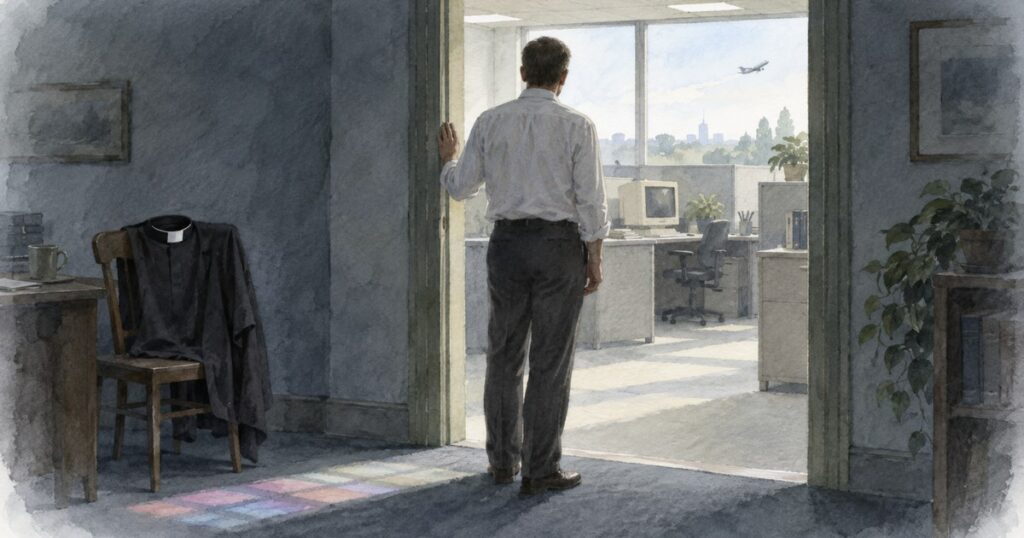
After I left the priesthood, I took temp jobs for about a year.
On paper it was a gap year. In real life it felt like standing in a doorway with no room on either side. I had spent six years in seminary becoming a priest. I had worn the collar and said the Mass. People knew who I was before I opened my mouth. Then, almost overnight, I was a man taking whatever temp work came along, in offices where nobody knew or cared what I used to be.
I remember working at an Anthem office near the airport. The temp agency placed me in longer assignments, weeks or months at a time, so I wasn’t sent to a new location every day. Even so, I was anxious every day I walked into that office. The corporate world was foreign to me. This was 1994, and I didn’t know much about computers. I knew I had to learn, and quickly.
That was one source of my anxiety, but it wasn’t the deepest one. The anxiety that went down to the core of my being came from being seen and treated as someone I myself did not know. I was no longer addressed as Fr. Green, but as Mr. Green, or Robert. Each time I heard it, I felt a wave of despair. I was making my way into a world where I was no longer special.
I was not only learning about a world that was foreign to me, I was experiencing the trauma of forging a new identity. No one was going to put me on a pedestal any longer (yes, priests are put on pedestals). No one was going to find my presence at their dinner table an honor. No one was going to catch me if I failed.
I had to rebuild my work life, and I had to make new social connections. Those were perhaps the toughest of all. A deep shame held me back from reaching out to old friends, and from reaching out to family. I recall my great-aunt saying to me, “Even though you are no longer a priest, we still love you.” Those words sounded so conditional to me.
I stood in that doorway afraid and alone. It took me several years to move forward, to accept who I was, and to find the strength to build a completely new existence and sense of being.
I didn’t have words for it then. I do now. I was living in what anthropologists call a liminal space.
The Threshold
The word comes from the Latin limen, which means threshold. The anthropologist Victor Turner used it to describe the middle part of any big life change, the stretch where you are no longer who you were and not yet who you will be. He called it being “betwixt and between.”
Here is what I have come to believe: leaving is not just an exit. Leaving is an arrival. You arrive at the threshold. And the threshold is a real place, with its own weather, its own fears, and its own gifts.
Years later, when I let go of the Christian faith altogether, I found myself back in that doorway. This time the questions were bigger. Not “What job will I do?” but “What does my life mean? Where do I fit in the world, if not where I was told I fit?”
You Have Probably Stood Here, Too
You don’t have to leave a church to know this place. Some of the thresholds I hear about most from people my age and younger:
- Between middle age and old age. You are not young, but you don’t feel old. The world, however, has started treating you differently.
- Retirement. For forty years the job answered the question “Who are you?” Then one Friday it stops answering.
- Losing a spouse. You are no longer a “we,” and you don’t yet know how to be an “I.”
- Divorce. The life you planned is gone, and the new one isn’t built.
- The empty nest, or the end of caregiving. The role that filled your days ends, and the days are still there.
- A diagnosis. You were healthy; now you are something else, and nobody gave you the map.
- Leaving a belief, a political tribe, or a community that once told you who your people were.
Different doors. Same doorway.
What Happens in the Doorway
In my doctoral work I developed a simple way of describing how a self comes into being. I call it EIR: Experience, Interpretation, Response. Something happens to us. We make meaning of it. We act on that meaning. And then we do it again, and again. The self is not a thing we have; it is something we keep becoming. I have written a free guide to the EIR Cycle, if you would like to go deeper.
The threshold puts real strain on all three.
Experience gets loud. Without the old routines to cushion things, everything hits harder. Silence is louder. Sunday mornings are longer.
Interpretation gets shaky. The old framework used to tell you what things meant. Now you have to decide for yourself, and you aren’t sure you trust your own judgment yet.
Response gets slow. You don’t know what to do next, so it’s tempting to do nothing, or to grab the first new certainty that comes along just to make the discomfort stop.
That last one is the trap I most want to name. The threshold is uncomfortable, and the quickest way out is to rush through the next door you see: a new church that looks just like the old one, a new relationship before the grief has been felt, a part-time job taken only so you’ll have an answer when someone asks what you do. Sometimes that’s the right move. Often it’s just a way of not standing in the doorway.
How People Learn to Stand There
Three things come up again and again in what others have told me. Two of them helped me. One I had to do without.
Learning to not know. The poet John Keats, in a letter to his brothers, wrote of a quality he called “negative capability”: being able to live with “uncertainties, Mysteries, doubts” without “any irritable reaching after fact & reason.” I love that word irritable. It describes exactly how I felt. Learning to say “I don’t know yet” without panic is a skill. It can be practiced.
Finding fellow travelers. Turner noticed that people who go through a threshold together often form unusually deep bonds. He called it communitas. When the titles and roles are stripped away, people meet each other plainly, as human beings. I believe Turner was right. But this is the one I went without.
I went into a dark place, and I remained there for several years. My anxiety turned into depression. Yes, I developed friendships at work, but I stayed at that threshold all the same. I believe that had I been able to connect with others during that time, my experience would have been very different, and perhaps not as painful. That was not me, though.
What finally moved me was going back to school. When I began work on my second master’s degree, I began to cross the threshold and let go. I let go of much (not all) of the baggage I had been carrying for many years. I began to see a future that had been hidden from me. I began to develop confidence, and a direction in life that brought me joy.
Making small rituals of your own. When you leave an institution, you lose its rituals: the Mass, the holidays, the calendar that told you what each day was for. Something has to take their place, but it doesn’t have to be grand. A morning walk. A journal. Coffee with the same friend every Thursday. These anchor the day without telling you what to believe.
The Gifts
I won’t pretend the threshold is pleasant. Mine was not. But I have come to believe that everything I met there was a gift, the bad along with the good. That includes the anxiety and the depression. They were my experiences, and I used them to forge a new life.
I did not see the depression as a gift at the time. I did not see the dark place I was in as a gift. It is only in retrospect that I see it was one, a gift I can now embrace as having meaning in my journey. This is EIR at work: something happened to me, I made meaning of it, and I acted on that meaning.
The threshold also gives things that are hard to get anywhere else.
Doubt becomes a compass. Inside a belief system, doubt is treated as a danger, a sign you’re drifting. On the threshold, doubt becomes a tool. It helps you test what is true for you and what you simply inherited.
You can finally see the walls. When you’re inside a system, it’s hard to see it at all. It’s just “the way things are.” Step outside, and the scaffolding becomes visible: the unspoken rules, the fears, the conditions placed on your worth. Now you can decide which parts you want to keep.
The present becomes the place you live. Old systems hand you a past (where you came from) and a future (what you’re promised). Take both away, and you are dropped into right now. At first that feels like vertigo. Over time, it can become a kind of freedom: the walk, the conversation, the meal, valued for what they are, not as steps toward some reward.
You Don’t Arrive Empty-Handed
One honest caution. Leaving does not wipe the slate clean. I still think like someone trained in theology. I still notice ritual, still care about how communities treat their weakest members, still reach for the language of meaning. The old life comes with you into the new one. Some of it you’ll put down. Some of it turns out to be worth carrying.
That, too, is part of arriving. You don’t become someone with no past. You become someone who chooses what to do with it.
Your Turn
I have stood in that doorway more than once: leaving the priesthood, leaving my faith, leaving my career, and now standing in the long doorway between one season of life and the next.
So I’ll ask you: What threshold are you standing in right now? And what has it given you that you didn’t expect? Tell me in the comments. If you think I’ve made the doorway sound too kind, tell me that, too.
