
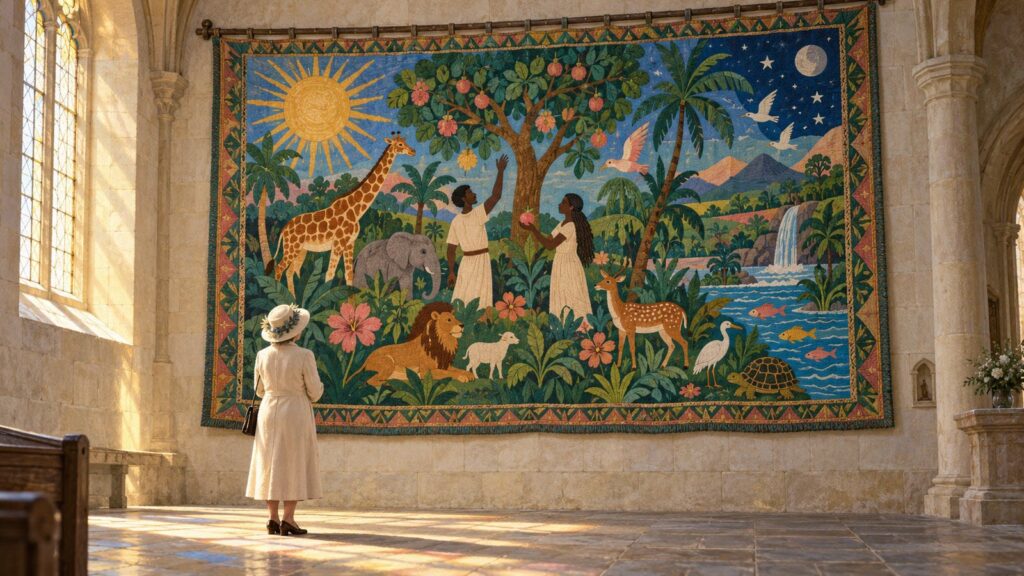
A woman once told me, in the church where I was the pastor, that a tapestry did not belong there because there were no White people in it.
It was a creation story woven by Haitian artists, and every figure in it was Black. I had hung it near the musicians because it was beautiful and because the parish, whether it liked it or not, now sat in a Black neighborhood. She was not shouting. She was not, by her own lights, being hateful. She was explaining to her priest, patiently, that God’s house had a dress code, and this did not meet it.
I had no words for her that day. I have had thirty years to find them, and the words turn out to be these: the God she was defending was not God. He was a mascot.
I know how that lands. So let me be careful about what I mean.
A mascot is a figure a group adopts to stand for itself. It wears the group’s colors. It shows up at the group’s gatherings. It is loved, and the love is real, but the love runs in one direction: the mascot exists for the group, never the other way around. Nobody asks what the mascot wants. Nobody worries the mascot might prefer the other team.
Now watch what happens to God in a great many congregations, and not only Catholic ones. He speaks the group’s language. He shares the group’s politics. He is comfortable with the group’s manners and uneasy with everyone else’s. He is, by some miracle, the same color as the people in the pews. When the neighborhood changes and new people arrive, he does not go out to meet them; he waits inside to see whether they will learn to behave. And when the group packs up and moves to the suburbs, he goes with them, because of course he does. He is theirs.
That is a mascot. It is not a mistake about God. It is a replacement for God.
I write that as a man who loved the liturgy and still does, so hear it as grief rather than contempt. The people who built those churches, who taught me to pray, who put a chasuble on my shoulders, were not frauds. Most of them were doing what every human group does: drawing a circle, putting the sacred at the center, and quietly assuming that the circle’s edge was the sacred’s edge too. The assumption is so natural that it is almost invisible. You only notice it when someone from outside the circle walks in and sits down.
Spinoza noticed it in the seventeenth century, and it got him thrown out of his synagogue. His whole argument, boiled down, is that if God is real, God is infinite, and if God is infinite, then nothing is outside God: not the Black family on the next block, not the divorced woman who stopped coming to communion, not the poorly dressed stranger nobody would touch at the sign of peace, not even Mrs. White. A God with an outside is a smaller thing wearing God’s name. And a God who can be kept inside a ZIP code, a skin color, a set of table manners, is not a smaller thing. He is a thing we made.
Here is the part that still unsettles me. I did not learn this from the people who left. I learned it from how easily I had gone along. For years I preached a universal God on Sunday and served an institution that practiced conditional belonging on Monday, and I managed the gap the way everyone manages it: by calling it human weakness and moving on. It was not weakness. It was the design. The circle was drawn before I arrived, and my job, as it turned out, was to keep it drawn.
So I will say the thing plainly, once. If the God you worship has never once asked you to open the door to someone you would rather keep out, you may want to check whether you are worshiping God or the team.
That is not an argument against faith. If anything it is an argument for a bigger one. The people I have known whose religion was the real thing were recognizable by exactly this: their God kept dragging them past the edge of their own circle, toward people they had not chosen. That is the test. Not the creed. Not the ritual. Not the building, however beautiful. Whether the circle gets wider or whether it gets defended.
I told the full story, including why I eventually took off the collar, in From the Altar to the Streets. This post is the one piece of it I keep coming back to.
So tell me: where is the edge of your circle? And when was the last time anything you call holy asked you to step past it? I would like to hear from you, and especially from anyone who thinks I have been unfair to Mrs. White.
