
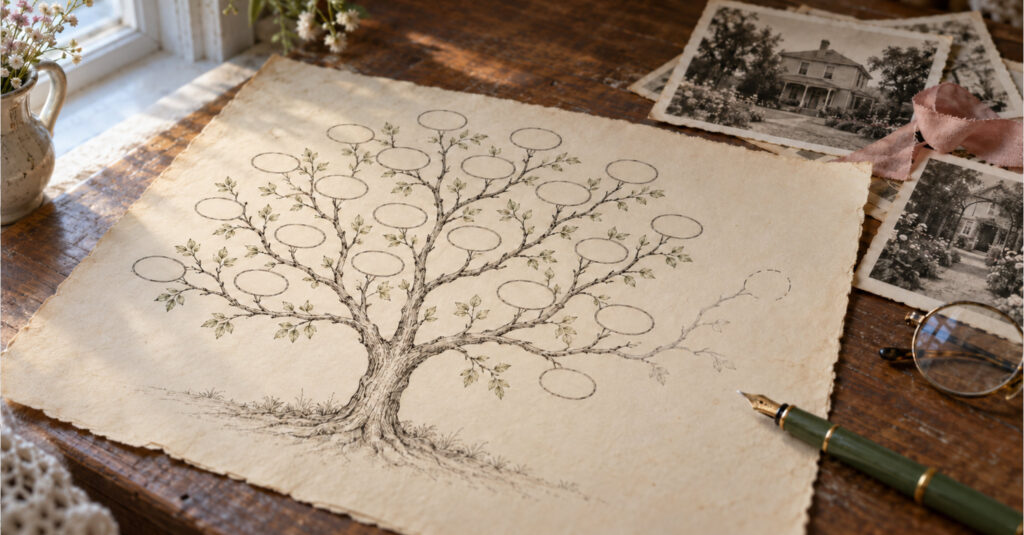
I have worked on my family history since the early 1970s. Several of us in the family do this work together. We trade records, chase down birth certificates, and fill in the branches of a tree that stretches back to Poland. One of the joys of family research is finding old photos and stories.
One branch we left alone. My third cousin, Kim Alleyn Badynski, born in 1955, carried his hatred from Chicago to the Pacific Northwest, where he became a leader of the Ku Klux Klan. None of us ever reached out to him.
We had reasons, and we took them seriously. One of my cousins who works on the family history is a Black woman. She is my second cousin once removed; her grandmother was my second great-aunt. I am a gay man, and for many years I was a Catholic priest. The Klan has hated Black Americans, gay people and Catholics alike. So the two of us, doing the same patient work on the same family tree, were each reluctant to contact Kim.
Kim died in 2019. I never met him. I have wondered what that silence means. I have family stories that were passed down, yet I still have a hard time getting my head around how a boy from our family became a man who led others in racial hatred.
Two Brothers at Boys Town
Kim’s father, Alfred, and his uncle Ernest lost their parents when they were young. Both boys were sent to Boys Town, Father Flanagan’s home for boys in Nebraska, and they lived there until they were old enough to leave.
The brothers grew up and built ordinary lives. Ernest became an art teacher. One of his sculptures, a small, buffalo-like figure of stone and metal called Cave Beast, is in the collection of the New Mexico Museum of Art in Santa Fe, where he died in 2011. Alfred married Janet, raised a family in Chicago, and lived long enough to travel with her in later life.
Kim was born while Alfred was serving in the U.S. military in Germany, in the city of Nuremberg. Nuremberg was the city of the great Nazi rallies, and of the war-crimes trials that followed the war, only about a decade before Kim’s birth. Nothing in that coincidence explains his later life, but I have never been able to forget it.
Learning to Be White in Chicago
Kim grew up in Chicago in a Polish American family. As a boy, I was fascinated by the stories about my Polish relatives and ancestors in Chicago. Only as I grew older, and began a lifelong educational journey, did I begin to hear the racism in many of the stories the adults told when they visited. Over the years, I came to realize that there was racism on both sides of my family.
Racial hatred in Chicago grew from deep roots. For generations, the city’s European immigrant groups (Polish, Irish, Italian, Lithuanian) were not fully counted as “White” by the Americans already there. The historian David Roediger has shown how immigrant groups, including Polish Americans, only gradually came to be seen as White, and how many claimed that status by defining themselves against their Black neighbors. Being White was not something they were born with in America. It was something they learned and defended.
That is what scholars mean when they say race is socially constructed. The categories are invented, but the consequences are real. Neighborhoods, jobs, schools and friendships were organized around them. On August 5, 1966, when Martin Luther King Jr. marched for fair housing through Marquette Park, on the city’s Southwest Side, he was struck by a rock thrown from a hostile White crowd. Kim was eleven years old that summer. A boy growing up in Chicago in those years absorbed lessons about who belonged and who did not, long before he could question them.
Racial Hatred Escalates: Crossing the Line, Then Climbing
Kim began in the Klan in the Chicago area. Around 1987 he went west, drawn by the Aryan Nations, and lived for a time at their compound in Idaho. In 1989 he settled in Tacoma, Washington, where, according to an activist newspaper, he opened Klan offices and a telephone hate line. A 1996 Anti-Defamation League report, preserved by the Nizkor Project, described him as head of the Klan’s Northwest region. The Southern Poverty Law Center identified him as Grand Dragon of the Northwest Knights of the Ku Klux Klan. Family accounts say his realm covered Washington, Oregon and Idaho, and that he also joined the racist skinhead movement, which in those years was allying itself with the Klan.
The social psychologist Roy Baumeister, in his book Evil: Inside Human Violence and Cruelty, offers a way to understand a path like this. Most evil, he argues, does not begin with monsters. It begins with a small step across a fuzzy line, and then it escalates. Groups speed the climb. Members outdo one another to prove their loyalty, private doubts go unspoken, and the most extreme voices set the tone. Even the Klan itself, Baumeister notes, began after the Civil War as a group of bored young veterans looking for something to do.
What a Family Tree Cannot Explain
It would be easy to draw a straight line from the past to the man Kim became: the brothers’ early loss, the prejudices of the older generation, the city he grew up in. Readers want that line. I want it too. But it isn’t there, at least not in any form I can prove.
Baumeister warns against exactly this kind of tidy story. He calls it the myth of pure evil, the comforting belief that people who do terrible things are a different kind of person from the rest of us. In his conclusion, he writes that evil does not live in our genes or our souls. It is enacted and constructed in the way we relate to one another.
My own work on humiliation led me to a model I call EIR: Experience, Interpretation and Response. Each of us is shaped by what happens to us, by what we decide it means, and by what we do next. Our responses then shape the experiences that follow. Two brothers lost their parents and grew up in the same institution. One became a teacher who made art. A generation later, Alfred’s son made a different series of choices, interpretation by interpretation and response by response, until racial hatred became his life’s work.
The family tree is the same. The paths are not. That is not a comfort, exactly, but it is a kind of hope. If racial hatred is learned, it can be unlearned. If it is chosen, it can be refused.
What Is Made Can Be Unmade
I never met Kim. I chose not to call him, and so did my cousin. I don’t regret protecting myself, but I do wonder what a conversation might have revealed. If I had the chance, I would ask him about his family, his schooling, his friends, and the Chicago neighborhoods where he grew up. I know that race and hatred are constructed and sustained by the society we live in. Still, I would want to hear it from him: what made him so hateful?
Hatred is made, not born. It is taught in kitchens and neighborhoods, sharpened in groups that reward it, and passed down in silences no one breaks. What is made can be unmade, though not always in one lifetime, and not always by the person who carries it.
Have you found a relative in your own family tree whose choices you struggle to understand? I’d welcome your stories, and your disagreement, in the comments.
