
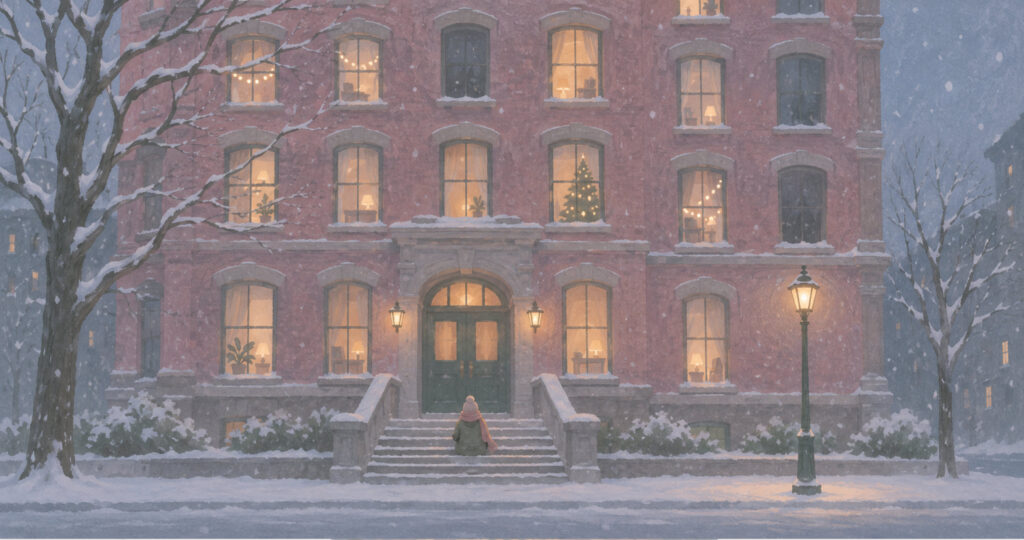
Part 1 of The Season We Built, a series on how November and December came to be the way they are.
Two calendars in one December
My first Christmas as a priest was December 1987. The pastor I served under kept Advent as Advent. No carols before the 25th, no tree in the sanctuary until Christmas Eve, and his Christmas cards did not go into the mail until the day after Christmas. He meant it. Advent was a season of waiting, he said, and you cannot wait for something you are already celebrating.
I understood him then and I understand him now. Liturgically, he was right. But I was standing between two calendars. Inside the church, it was Advent. Outside the church door, it had been Christmas since the Friday after Thanksgiving. The stores, the streets, the radio, the office parties, the family gatherings, the school programs: all of it was Christmas, and none of it was going to wait for us.
The people in the pews were trying to live in both. They lit the Advent candle on Sunday morning and went to a Christmas party on Sunday night. They opened a window on the Advent calendar at breakfast and sang along to Christmas songs in the car on the way to work. Nobody hosts an Advent party. Nobody ever has. So every Sunday I preached waiting to people who had no way to wait, and I could feel what the preaching did. It put a pall on their fun. A young priest telling people there was no Christmas until Christmas was not a prophet. He was a man asking them to live in a calendar that no longer existed anywhere but inside the church walls.
I did not have words for that tension then. I had a feeling I could not name, something between embarrassment and grief, and I set it aside for about forty years. This series is the words.
The season we built feels like weather
Here is the thing I eventually noticed. The holidays feel like weather. They arrive. Nobody decides that the season will begin the day after Thanksgiving; it simply does. Nobody votes on the music, the colors, the food, the obligations, the guest lists, the budgets, or the rule that everyone will be cheerful. These things come down on us the way snow does, and like snow, we take them as given. You can complain about the weather, but you cannot ask who made it.
Except that someone did make it. Every piece of the season we built was put there by somebody, for some reason, at some time, and most of those reasons were not the ones printed on the greeting card. The date of Christmas was chosen. The tree was imported. The shopping season was invented, and then moved. The turkey, the cards, the office party, the charity drive, the stockings, the elf, the “Merry Christmas” and the “Happy Holidays” and the fight between them: each one has a history, and in each history there are people who benefited and people who paid.
The holidays are not weather. They are a building. And buildings have owners, tenants, and people sleeping on the steps.
For the next eight weeks I am going to walk through the building and ask who it was built for.
Four questions I will keep asking
I am a sociologist, and sociologists are tiresome at parties because we keep asking the same four questions. I will ask them of every room in this building.
Who built this? Not God, not tradition, not “the way it has always been.” Somebody. A pope, a merchant, a magazine editor, a department store, a president, a committee. The season we built has architects, and most of them had names.
Who benefits? Every holiday custom pays someone. Sometimes the payment is money. Sometimes it is attention, legitimacy, labor, or the quiet pleasure of being the kind of family that does things right.
Who pays? Someone always does. The cashier who works Thanksgiving night. The woman who makes Christmas happen for a household that never notices it was made. The child who learns that love arrives in a box. The person whose December is the darkest month of the year and who is told, in a hundred cheerful ways, to get over it.
And who is told to smile anyway? This is the question I know best, because I have spent my career studying humiliation, which is what happens when a person is required to perform contentment with an arrangement that is costing them something. A great deal of December runs on that requirement.
What this series is not
Let me be clear about what the season we built is not going to be, because I know how a series like this can sound.
It is not a war on Christmas. I am not interested in taking the season away from anyone. The lights are beautiful. The food is good. The reunions are real, and so is the warmth, and I will say so when it is true.
It is not an argument against joy. Joy is not the problem. The problem is who gets it, who provides it, and who is told their lack of it is a character flaw.
And it is not a sermon. For years I preached Advent on Sunday mornings to people who went back to Christmas on Monday, so I know exactly what a sermon can do and what it cannot. This is a walk through a building with a friend who happens to know something about how buildings get made. You can argue with me the whole way.
My own December, now
I should tell you where I stand, since I am asking you to walk with me.
I am no longer a Christian. I am not an atheist either; that word has never fit. The closest I can come is Spinoza, who saw the divine not as a person in the sky but as the whole living, generating reality we are part of. That is what I celebrate in the dark weeks of the year, and I celebrate it with a tree and good food and the people I love.
And here is the odd part. I enjoy the time before Christmas far more now than I did in a Roman collar. I am no longer obliged to insist that Jesus is the reason for the season. I am no longer obliged to keep Advent as Advent while the world around me refuses to. I can light a candle because the night is long and the light is good. The season got better for me when I stopped having to defend it. That is worth thinking about, and it is one of the places this series is headed.
The road ahead
Here is the building, room by room. Fifteen pieces, Mondays and Thursdays, through New Year’s Eve.
November 12: Nobody found the holidays under a tree. How the season was assembled, piece by piece, and by whom.
November 16: Who the holidays work for, and who works the holidays. The people whose December is a shift schedule.
November 19: A turkey in November, silence in March. Why seasonal charity is not justice.
November 23: The Thanksgiving we agreed to remember. The story we tell and the one we don’t.
November 27: Black Friday. The people who cannot go home for the holidays because the rest of us are shopping.
November 30: The church that couldn’t wait. Christmas parties in Advent, and what the pastor was right about.
December 3: “Jesus is the reason for the season.” A claim about property, not theology.
December 7: The war on “Happy Holidays.” What a greeting threatens, and to whom.
December 10: “Christmas is for the kids.” The alibi that raises little consumers.
December 14: Who makes Christmas happen? The invisible labor of the season.
December 17: The longest night. When the season is a darkness, and how we might be better company in it.
December 21: The perfect holiday nobody is having. Social media and the manufactured December.
December 28: The morning after. What the season leaves behind.
December 31: Who paid for our holidays? Closing the series, opening the year.
An invitation
Read these with your own December in mind. Think about the rules your family keeps that nobody remembers choosing. Think about who, in your house, makes the holidays happen and who merely attends them. Think about the people who are not at the table, and why.
And argue with me. I mean that. The comments on this site are open, and I read every one. I would rather be corrected by a reader who knows something I don’t than agreed with by one who was being polite. That, too, is a kind of Advent: waiting to find out what you were wrong about.
So here is my question for you, to start us off. What is one holiday rule in your family that nobody chose but everybody obeys?
