
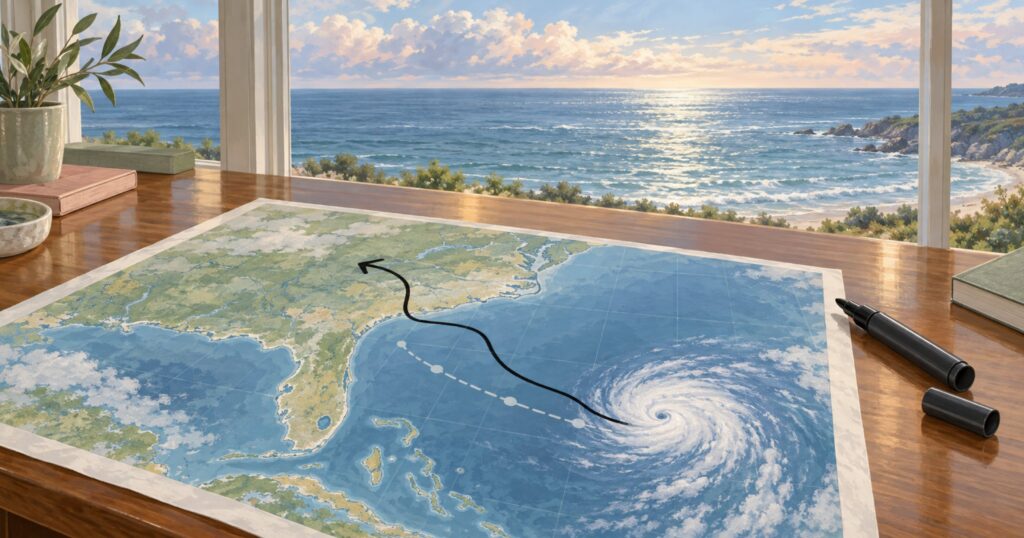
In September 2019, the President of the United States sat in the Oval Office and held up a hurricane map. Someone had extended the storm’s projected path with a black marker so that it reached Alabama. Days earlier he had warned that Alabama would be hit hard, and the National Weather Service office in Birmingham had told residents, plainly, that it would not. The map had to be made to agree with him.
What stays with me is not the marker. It is what came next. A Commerce Department inspector general later found that, under pressure from the White House, the leadership of the nation’s weather agency issued an unsigned statement rebuking its own forecasters, who had done nothing but tell people the truth so they would stay safe.
Seven years later, at a rally in Clarksville, Tennessee, the same man mused aloud that the country already had its renamed gulf and its renamed lake, and now it needed an ocean. Perhaps the Atlantic or the Pacific could become “Trump Ocean” or the “Ocean of the Americas.” The crowd laughed and cheered. Eleven days later he dropped the idea, saying Google’s CEO had asked him not to.
It is tempting to file these moments under comedy and move on. I want to do something else. I want to look at them from four directions at once: from inside the man, at what he actually does, at the culture that hears him, and at the systems that make room for him. A way of seeing is a way of not seeing, as Kenneth Burke taught us. Any one of these views alone will miss most of what is going on, and it will miss us.
Inside the Man: What We Can and Cannot Know
I will be honest about my first instinct. When I watch Donald Trump, I want to reach for a diagnosis. Narcissism is the word most of us reach for. But I am a sociologist by training, not a psychologist, and I have never sat in a room with him.
The people who do diagnose for a living hold themselves to a rule here. Since 1973, the American Psychiatric Association has asked its members not to give professional opinions about public figures they have not personally examined, and it reaffirmed that rule in 2017. Not everyone in the field agrees with it. Still, if experts hesitate, I should too.
So I will not name a disorder. What I can name is a pattern, and the pattern is right there in public. When reality and Trump’s self-image disagree, reality is asked to give way. The storm must go where he said it would go. The ocean should carry his name. The rumor must be true because he repeated it.
Whether that comes from something clinical, from strategy, or from a lifetime of never being told no, I cannot say. What I can say is that from the inside, this pattern seems to work for him. A man who experiences the world as something to be named after himself will keep trying to rename it.
What He Does: The Public Record
If we set the inner life aside, we are left with behavior, and behavior can be checked. Here are a few of the statements that most people, whatever their politics, would call ludicrous. Each one links to a fact-check or a news report I have looked at, so you can judge for yourself.
| When | What he said | What the record shows |
|---|---|---|
| Oct. 2026 | The U.S. needs an ocean; perhaps the Atlantic or Pacific could become “Trump Ocean” | Floated at a Tennessee rally, then dropped eleven days later (TIME) |
| Sept. 2024 | Immigrants in Springfield, Ohio, were eating residents’ dogs and cats | City officials and police said there were no credible reports of it (PolitiFact) |
| Apr. 2020 | Wondered aloud whether disinfectant could be used “by injection inside” to fight COVID-19 | The next day he said he had been speaking sarcastically (FactCheck.org) |
| Sept. 2019 | Hurricane Dorian would hit Alabama; displayed a marker-altered map | Forecasters said Alabama would see no impacts; an inspector general faulted the agency’s response (CBS News) |
| Apr. 2019 | The noise from wind turbines causes cancer | The American Cancer Society said it knew of no credible evidence for this (AP) |
Look at the list as a whole and something stands out. These are not slips of the tongue. Each one bends a fact toward a story: the country needs more of his name on it, the stranger is dangerous, the expert is wrong, the thing he dislikes is deadly.
The philosopher Harry Frankfurt drew a useful line between lying and what he bluntly called bullshit. The liar cares about the truth enough to hide it. The other speaker simply does not care whether what he says is true, only whether it works. That, to me, describes this record better than the word delusion does.
The Culture That Hears Him
A man saying strange things is a curiosity. Millions of people cheering is a culture. The more important question is not what is happening inside Donald Trump, but what is happening inside us, collectively, that makes his voice sound like home to so many.
What “Again” Means
Trump did not invent “Make America Great Again.” Ronald Reagan campaigned on it in 1980, and Bill Clinton used nearly the same words in 1991. The phrase is older than the movement.
What matters is the word again. Again points to a time in the past when the country was great. So the honest question is: great for whom? For a White man like me in the 1950s, perhaps. For Black Americans living under Jim Crow, for a gay man in a seminary, for a woman who could not get a credit card in her own name, not so much. That is why MAGA works as a code. One person hears nostalgia for steady jobs and safe streets. Another hears a promise to put people back in their places. The phrase lets both hear what they need, and no one has to say the second meaning out loud.
Fundamentalism and the Fear of the Stranger
Fundamentalism, religious or otherwise, offers certainty in a world that feels like it is coming apart. It draws a clear line between the saved and the lost, the pure and the contaminated. I have written about the God some of us keep in a ZIP code. That God has borders, and someone is always on the wrong side of them.
The Springfield story shows how quickly that line becomes a target. A rumor that Haitian immigrants were eating pets moved from social media to a presidential debate stage in days. It was false. But it fit a story people already carried about the stranger: unclean, dangerous, taking what is ours.
The Line, and the Humiliation
The sociologist Arlie Hochschild spent five years with supporters of the American right in Louisiana. In Strangers in Their Own Land, she described what she called a deep story: people waiting patiently in a long line for the American Dream, watching others cut in front of them, and feeling dismissed by the very people they believed were letting the line-cutters through.
Here is where my own work comes in. I spent years studying humiliation. One of the things I learned is that people will forgive almost anything except being made to feel small. Part of the deep story is being looked down on, called backward or ignorant by people who seem to have it easier. Trump looks at that crowd and does the opposite. He tells them they are the smartest, the most loyal. Whether or not he means it, he is offering them their dignity back, and dignity is something we do, or fail to do, for each other.
The Systems That Make Room for Him
Go back to the hurricane map. The marker was one man’s act. The unsigned statement that rebuked the forecasters was a system’s act. Career officials, under pressure, decided it was safer to side with the fantasy than with the forecast. That is the part that should frighten us more.
I have argued before that the systems we build, build us in return. Systems reward some behaviors and punish others, and over time the people inside them learn what is safe. When the price of telling the truth goes up, fewer people tell it.
An Unlikely Coalition
Who, then, keeps this system running? The easy answer is the poor and the uneducated. The data say it is more complicated. In Pew Research Center’s study of validated 2024 voters, about two-thirds of Trump’s voters did not have a four-year degree. That leaves one in three who did. Nearly half lived in the suburbs, and his coalition was more racially diverse than in either of his earlier campaigns.
And a college degree is not the same thing as wisdom. I have known persons with three degrees who could not see past their own privilege, and persons who never finished high school who saw straight through a con. I say that as a man with more than his share of degrees.
What the coalition does reveal is an old arrangement. Those with wealth and power want lower taxes, fewer rules and a free hand. Those who feel left behind want to be seen and to have someone to blame. A leader who can give the first group policy and the second group a story holds them both. In 2016, after winning Nevada, Trump told the crowd he loved “the poorly educated.” I cannot see into his heart, and I will not claim to know what he secretly feels. I can see that the people who most need the system to change are the ones being asked to defend it.
That is how privilege and oppression meet. The arrangement does not need anyone to be stupid. It only needs each group to keep looking at the other, and never at the structure that holds them both in place.
The Emergent Self, and the Country We Are Becoming
In my doctoral work I described the self as a continual cycle of Experience, Interpretation and Response. We are not fixed things. We are verbs, always becoming. I think a country works the same way.
Millions of Americans have had a real experience: wages that stalled, towns that emptied, churches that shrank, and a sense that someone was looking down on them. That experience is not imaginary. The question is the interpretation. Trump offers one: the stranger did this, the expert lied, the line-cutters took your place, and only I can fix it. The response follows from the interpretation, and the response is what we are now living through.
In fairness, many of his supporters would tell this story differently. They would say they are not voting for his strangest sentences but against an establishment that ignored them, for secure borders, for the faith they were raised in, and for someone who fights instead of apologizing. I do not think that account answers the harm, but I do think it deserves to be heard in their own words rather than mine.
The cycle runs through all of us, including those of us who oppose him. If my response to a neighbor wearing a red hat is contempt, I have just added a page to his deep story. I have become one more person in the line looking down on him. Contempt feels like clarity, but it is humiliation dressed up as wisdom, and humiliation is the very fuel this movement runs on.
The Sharpie on the map is a good image to end with. One man drew a line where he wished the storm would go. Then a whole system decided to agree with him. The storm, of course, went where storms go. Reality does not take dictation. Our only real choice is whether we, as individuals and as a people, are willing to see it.
So here is my question for you. When you think of the people who cheer these moments, what story do you tell yourself about them, and what would it take for you to hear the story they tell about themselves? I welcome your disagreement in the comments.
