
The Paradox of the Altar
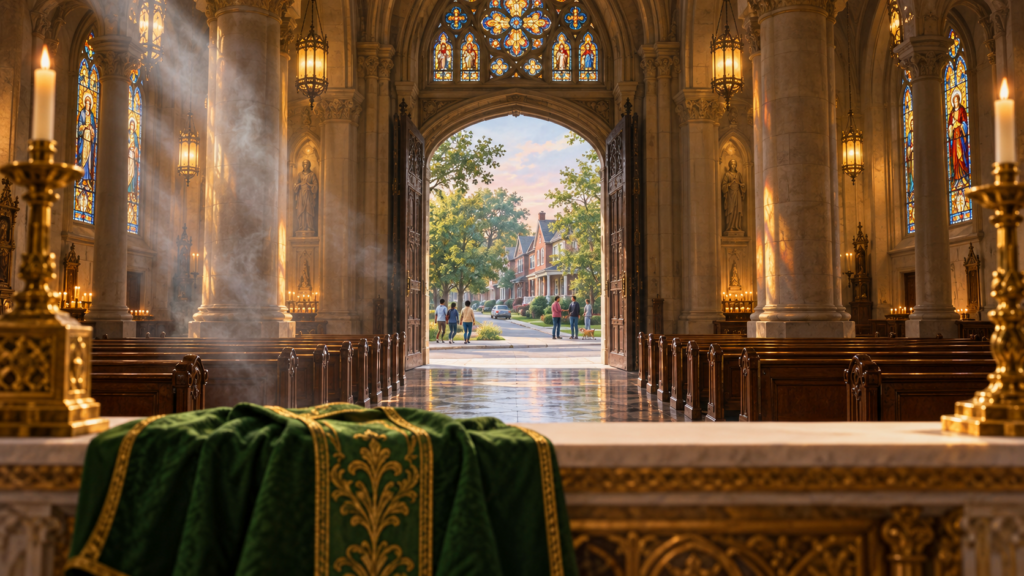
The chasuble had weight to it. People who have never worn one imagine it as a costume, something light and theatrical. It is not. It settles on the shoulders like a responsibility, and for years I welcomed that weight every morning. I loved the smell of incense caught in the folds of old cloth. I loved the choir singing. I loved the silence that filled a church full of people, a silence so complete that the whole congregation seemed to hold a single breath. I loved the chants, the candles, the way light came through the windows at the early Mass and fell across the altar. I am not going to pretend otherwise. Whatever I came to think later, I was a man in love with the liturgy.
I still remember my first Mass as a newly ordained priest. I can see the church, about five hundred people singing as I placed incense in the censer, bowed to the altar, and walked around it swinging the censer, our collective prayers rising to God with the smoke. The pipe organ played and the congregation sang. I remember praying the Eucharistic Prayer with my brother priests, who concelebrated the liturgy with me.
I served as a priest on the near-northside of Indianapolis, in a parish whose church had been built by people who expected it to stand forever. It did stand. It stood tall and handsome while the neighborhood around it changed, block by block, into something its builders had not imagined. Inside, the liturgy whispered the same words it had whispered for centuries: one body, one bread, one people gathered at one table. Outside, the people were sorting themselves by color and by fear.
That is the paradox I lived inside for years. The most beautiful thing I have ever known was housed in an institution that could not practice what the beauty proclaimed. It took me a long time to understand that the beauty was real and the proclamation was hollow, and that both of those things could be true at once.
I have been reading Spinoza lately, the seventeenth-century philosopher who was thrown out of his own synagogue in Amsterdam for ideas the elders could not tolerate. He has become an unexpected companion in making sense of those years. Spinoza loved truth the way I loved the liturgy, and he spent much of his life asking why religious institutions so reliably trade the one for power. He would have understood the near-northside better than many of the people who lived there.
The Illusion of the Sacred Bound
White flight does not announce itself. No one stands up at the end of Mass and says they are leaving because Black families have moved onto their street. It happens the way erosion happens. A family that had sat in the same pew for thirty years is simply not there one Sunday, and then not there the next. The envelopes grow thinner. The committee that ran the fish fry cannot find volunteers. The school shifts from predominantly White to predominantly Black because the young White families have moved farther north. Someone mentions, carefully, that they have found a parish “closer to the grandchildren” out in the suburbs. The building stays. The presence, the money, and finally the empathy leave.
I want to be fair to the people who left. They were not villains. Most of them were frightened, and fear is rarely original. They had absorbed it from parents, from neighbors, from newspapers, from a lifetime of social conditioning that told them who belonged near them and who did not. Fear like that does not feel like prejudice from the inside. It feels like prudence. It feels like looking after your family. That is exactly what makes it so hard to confront from the pulpit, and I did not always confront it well.
I remember a school Mass one February when we celebrated Martin Luther King Jr.’s birthday. I placed a picture of Dr. King near the altar. My homily was about love, and about holding up the ideals of a great spiritual leader. I told the students that when they had a problem with a classmate on the playground, they should stop, look at that classmate, and ask, “Don’t you remember the dream?” After Mass, as I was tending the candles and putting away the chalice and paten, a group of older parishioners who came to Mass every day walked up to the altar. One of them spoke for the group. “Father Green, we need to say something.” I asked what they wanted to say. “Father, what is that picture doing near the altar?” I turned and said, “That is Dr. Martin Luther King Jr. We just celebrated Mass and remembered him in the liturgy.” “Well, Father,” one of them said, indignant, “it does not belong near the altar!” They went on for a while about what I had done wrong. Perhaps I should not have said it, but when they finished I told them, “Please know that I will pray for your bigotry.” “Father,” they answered, “we are going to pray for you!” I thanked them and said I could use their prayers.
On another occasion I hung a large hand-woven tapestry near the place where the musicians sang and played. It told the creation story with Black Haitian figures, and it was a beautiful piece of work. A parishioner named Mrs. White (yes, that was her name) confronted me. There were no White people in the tapestry, she said, and it did not belong in a Catholic church. I was so dumbfounded I had no words.
Spinoza saw this pattern three and a half centuries ago, and he named it with a precision I did not have as a young priest. In his Theological-Political Treatise he argued that most of what passes for piety is something else wearing piety’s clothes. People mistake loyalty to their own sect, their own customs, their own kind, for devotion to God. They defend the boundaries of the group and believe they are defending the sacred. Spinoza thought superstition grew out of fear, and that institutions learned to feed on that fear because frightened people are easy to govern.
What I slowly understood on the near-northside was that the “sacred community” I had been ordained to serve was, for a good many of its members, a socio-cultural comfort zone with a cross on top. As long as the neighborhood looked like the congregation, no one had to notice the difference. When the neighborhood changed, the illusion shattered, and what remained was not the Body of Christ but a demographic. A God who can be kept inside a particular ZIP code, a particular skin, a particular set of manners, is not God at all. He is a mascot.
I do not say that with contempt. I say it with grief, because I had believed in that community too.
The Anatomy of Exclusion
Race was the most visible line the parish drew, but it was not the only one. The Church I served had a long list of people it welcomed with conditions: the divorced and remarried who could not approach the altar, the gay men and women who could sit in the pews so long as they said nothing true about their lives, the poor whose presence was tolerated at the food pantry door but not quite in the front pew. Every institution has a membrane. Ours was supposed to be made of love. In practice it was made of rules about who counted. And the membrane showed itself in small ways as often as large ones.
I recall a Sunday when several babies were crying in church. We had no cry room, as some churches do, and I could see the frowns and the frustration in the pews all through the liturgy. At the end of Mass, before the final blessing, I walked from the altar to the front of the congregation and asked people to be seated. “I am going to say something that some of you may not like,” I said. “Yes, we heard the prayers of some babies during Mass today, and I saw the frowns. Please, let me remind each of us: the day we no longer hear the cries of the little ones during Mass, we have died as a church.” Most of the congregation stood and applauded. I still get emotional when I remember it.
At an earlier parish in Columbus, Indiana, where I served as associate pastor, a person came to Mass one Sunday who was not well dressed and, frankly, not very clean. They sat near the back, and I watched the people around them avoid shaking their hand at the sign of peace. I am not saying the whole congregation snubbed them; most never saw. But I did. I walked from the altar to the back of the church, embraced the person, and welcomed them to Mass. They smiled and thanked me.
Here Spinoza gave me the idea I most needed. For him there is only one reality, infinite and undivided. He called it God, or Nature, as if the two words named the same thing, because for him they did. Nothing stands outside it. Every person, every tree, every stone on the near-northside is a particular expression of that one generative whole. In my own writing I have come to call it Immanent Generativity, the activity by which reality continually brings itself forth, but the point is the same under any name. There is no outside.
If that is true, then exclusion is not merely unkind. It is incoherent. To cast a human being out of the community is to attempt to cut off a piece of the Divine and set it on the curb. You cannot do it. You can only pretend to, and the pretense costs you something: it makes your theology smaller than the reality it claims to describe.
I could preach a universal God on Sunday and watch the institution practice conditional belonging on Monday. For a while I told myself the gap was human weakness, the ordinary distance between the ideal and the real. Eventually I could no longer tell myself that. The gap was not a failure to live up to the theology. The gap was built into how the institution understood itself. My conscience could hold a theology of universal love or an institutional practice of conditional belonging. It could not keep holding both.
The Intellectual Exodus
I would like to tell you that when I took off the collar I walked straight out of the sacristy and into the wide Spinozan universe, free and clear-eyed. That is the version that would make a good ending. It is not what happened.
What happened is that I left one institution and discovered I had no idea how to live outside of one. I had gone from my parents’ house to the seminary and from the seminary to the rectory. The Church had told me when to rise, what to wear, what to say, where to live, and what I was for. It had also told everyone else what I was for. Strangers called me Father. Then, almost overnight, they called me Mister, or Robert, and each time it happened I felt a small wave of despair. I was no longer special. I temped for about a year, taking assignments that ran a few weeks or a few months, learning computers from scratch because I had never needed to know them. The men and women around me had been living in the world for twenty years. I was a beginner with a theology degree and no map.
And I felt guilty. Not guilty for leaving, exactly, but guilty the way you feel when you walk out of a family dinner in the middle of an argument. I had abandoned my post. I had let down people who had trusted me. A great-aunt told me, kindly, that even though I was no longer a priest, they still loved me, and all I could hear in it was the word “even.”
The anthropologists have a word for this stretch of life: liminality, the threshold between one identity and the next. I stood on that threshold for years. Anxiety deepened into depression, and I was in a dark place for longer than I like to admit. I say that now without shame, because in retrospect I count those years among the gifts of the threshold, though I certainly did not experience them as gifts at the time.
What slowly pulled me across was not a sudden conversion to philosophy. It was the long, unglamorous work of learning how to be a person in the world: holding a job, then a better job, then a career at a large corporation; starting a second master’s degree and finding, to my surprise, that I was good at it and that it brought me joy. Nearly a decade passed before I could look back at the altar without flinching.
But something had changed in that decade, and Spinoza helps me name it. I no longer had to defend an institution’s flaws. For years, part of my mind had been assigned to explaining away what the Church did to the people it excluded. When I left, that part of my mind was released for other work. I could seek truth, equity, and understanding wherever they led, through reason rather than dogma, and nobody could silence me for it. I had traded a parish with geographical and cultural boundaries for a universe with none. It just took me ten years to notice the trade had been a good one.
True Piety
Spinoza was accused of atheism his whole life and for centuries after his death. It is a strange charge against a man who wrote more about God than almost any philosopher of his age. What his accusers could not forgive was that he refused to let God be owned. He stripped away the rituals, the creeds, the ceremonies, the whole apparatus by which one group proves it is holier than another, and asked what was left. His answer was simple enough to fit on a card. True religion, he said, consists in justice and charity: in dealing fairly with people and in loving your neighbor. Everything else is custom. Custom can be beautiful. I still think the Mass is beautiful. But custom is not the thing itself, and when custom is used to decide who may stand inside the circle, it has become the enemy of the thing itself.
By that measure, the near-northside parish was failing at religion in the very years it was succeeding at liturgy. And by that measure, so was I, for as long as I stayed to defend it.
I did not leave the priesthood because I stopped caring about what is holy. I left because I found that I could not honor it from inside a structure built to ration it. The Divine, if the word still means anything, is not waiting behind the altar rail for the right people to approach. It is in the unfiltered, undivided world: in the Black families who moved onto those streets and were met with locked doors, in the divorced woman who stopped coming to communion, in the gay couple in the back pew, in the crying babies, in the unwashed stranger at the sign of peace, in the frightened White parishioners who fled, and yes, in the man in the chasuble who took too long to see it. There is no outside. That is the whole of what Spinoza taught me, and it is more than the seminary ever did.
I still love the smell of incense. I have simply stopped believing it marks the boundary of the sacred.
So I will ask you what I eventually had to ask myself. Where have you mistaken the comfort of your own kind for devotion to something larger? And what would it cost you to find out? I would like to hear your answer, especially if you think I have this wrong.
