
A Gentle Reminder
Some years ago I was invited to join a human dignity board forming at a university. I loved that group. People said what they thought, and nobody pretended.
One afternoon someone asked a question, and I answered it. At length. In the confident, settled tone of a man who has been listened to his whole life. When I finished, the group’s leader, a woman I love and admire, gently reminded me of my White male privilege.
I wasn’t insulted. I wasn’t angry. I was caught. I have spent years studying how privilege and oppression meet in people’s lives. I have lived on the losing side of that line as a gay man and as a priest who walked away from the priesthood. And still, in that room, my voice took up space it had never been taught to question. I had one foot in each camp, and I hadn’t noticed which one I was standing on.
That moment taught me something I keep relearning. Most of what we do is not decided. It is absorbed. We breathe in the habits of the places that raised us and employed us, and then we breathe them back out as if they were our own.
Which brings me to some unsettling research about the people who run our largest companies.
What the Numbers Say
Start with flattery. Researchers surveyed CEOs, their top managers, and the journalists who cover them. Managers who flattered and agreed with their CEO tended to grow resentful of that CEO. Then, often anonymously, they undermined the CEO with the press through faint praise and quiet digs. The smile in the boardroom and the knife in the newspaper belonged to the same people.
Now ethics. In a 2024 global survey of more than 5,400 people, 67% of board members and 51% of senior managers said they would act unethically in at least one way to advance their careers or pay. Among ordinary employees, the figure was 25%. Two-thirds of board members also said they feel pressure not to report misconduct.
Then the numbers themselves. Chief financial officers estimate that about 1 in 5 public companies manage their earnings to misrepresent performance in any given period. In an earlier survey of 401 financial executives, 78% said they would give up real economic value to make earnings look smooth. More than half would pass on a very profitable project if it meant missing a quarterly target. That is not fraud. It is ordinary, legal, and freely admitted.
And when it is fraud, it usually starts at the top. In 347 alleged accounting frauds investigated by the SEC over a decade, the agency named the CEO, the CFO, or both in 89% of cases. What gets caught is only part of it. One team of economists estimates that only about one-third of corporate frauds are ever detected.
None of this means most executives are crooks. Saying you would bend the rules is not the same as bending them, and being named is not being convicted. But the pattern is hard to wave away. The higher people climb, the more willing they say they are to trade integrity for advantage, and the more the system around them rewards the trade.
How the Systems We Build Pull Decent People In
It would be comforting to blame a few rotten people. The research doesn’t let us off that easily. A review of more than 30 years of studies found that unethical choices at work come from the person, the situation, and the organization all at once. Bad apples, yes. But also bad barrels.
I think about it this way. Every one of us lives in a cycle: something happens to us, we make sense of it, and we respond. Experience, interpretation, response. Then the response becomes part of the next experience, and the cycle turns again. As I wrote in People Are Verbs, we are not fixed things. We are always becoming.
Here is what organizations do to that cycle. They rarely change what happens to us. They change how we read it. A new manager experiences the CEO’s power. The culture hands her the interpretation: agree, flatter, don’t make waves. Her response feels like her own choice. It isn’t entirely. It was scripted before she arrived.
The same goes for the CFO who smooths the numbers. He experiences the pressure of a quarterly target. The system tells him what that pressure means: miss it and you’re finished. He responds the way nearly everyone around him responds. Nobody had to order him to do it. The interpretation did the ordering.
The Systems We Build, and Then They Build Us
But systems don’t fall from the sky. People make them. Someone decided that pay would ride on the stock price. Someone decided which numbers mattered every ninety days. Someone decided who gets promoted and who gets called “not a good fit.” Those someones were people living their own cycles of experience, interpretation, and response.
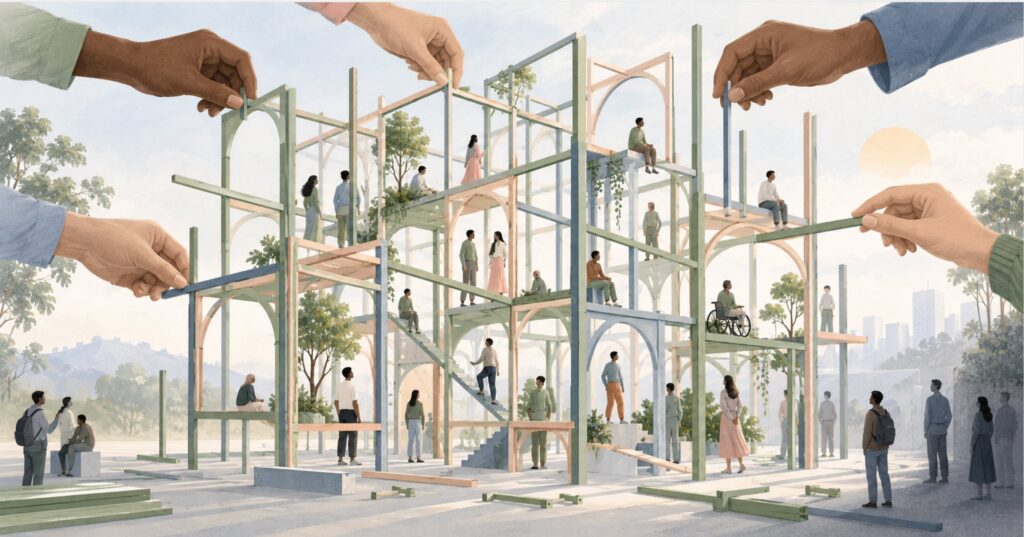
So it is not either the person or the system. It is both, turning together. We build the rules. The rules teach us how to see. What we see shapes what we do. What we do hardens into the next set of rules. Over time the whole arrangement stops looking like something people made. It starts looking like the way things are.
I spent most of my working life inside a Fortune 50 company, much of it with the Medicare program. I watched good people, people I liked, learn to talk and think like the place. I learned it too. Nobody handed us a manual. We picked it up the way children pick up an accent.
That is the quiet power of a system. It doesn’t have to force anyone. It only has to make one way of seeing feel like common sense.
Who Pays, and How Much
Common sense is never neutral. It is written by whoever held the pen. For most of the history of American business, the pen was held by White men who looked like me.
Go back to the flattery study. The researchers found that the resentment was especially likely when the CEO was a racial minority or a woman. Same flattery, same deference, but it curdled faster. Why? Because the system had taught those managers, without anyone saying it out loud, who belongs at the top. When the wrong person sat in the chair, bowing to her felt like an injustice. And the knife came out sooner.
That is what it looks like when privilege builds a system. Nobody writes “Black women need not apply.” Instead the system defines leadership in a familiar shape: a certain voice, a certain confidence, a certain way of taking up a room. The voice I used on that dignity board. Anyone who doesn’t fit the shape has to work twice as hard to be heard and pays twice as much when they stumble.
I saw the same pattern decades ago as a priest on the near-northside of Indianapolis. As the neighborhood became predominantly Black, the parish pulled back its presence, its money, and its empathy. No one voted to abandon anyone. People simply followed the habits of the system they belonged to, and the system did the rest.
For people at the intersections of oppression, the cost is not occasional. It is daily. It is being treated as other in rooms they helped build. It is policies that were never aimed at them but land on them anyway. It is the slow work of proving, again and again, that they are fully human.
What Privilege Costs the Privileged
The cost is not equal. Let me be clear about that. A board member who keeps quiet about misconduct will not lose what a Black worker loses to a policy that was never meant for her. But there is a price at the top too, and the research hints at it.
Think about the CEO in that flattery study. He is surrounded by people telling him he’s right. Some of them resent him for it, and some are quietly working against him. He may never know which. Privilege bought him agreement. It cost him the truth.
Think about the 43% of board members who saw misconduct in the past two years and chose not to report it. Or the executives who knowingly give up real value to keep the numbers smooth. These are some of the most powerful people in the economy. They do not sound free. They sound trapped in a game they were rewarded for winning.
And there is a deeper cost, one I know firsthand. Privilege narrows what you can see. It let me speak at length on that dignity board without noticing the people who were waiting to speak. Every time a system makes your way of seeing feel like the only way, you lose a little of your ability to recognize someone else’s humanity. You lose a little of your own along with it.
That is the trade. Comfort, power, and the benefit of the doubt, paid for with honesty, real relationships, and the capacity to be surprised by another person.
The Systems We Build, We Can Rebuild
Here is the hopeful part, and I mean it. If people built these systems, people can build different ones. The cycle that pulls us in can also pull us out. It starts with the step in the middle: interpretation. The moment we notice that “common sense” is somebody’s sense, we have a choice we didn’t have before.
That is what happened to me on that dignity board. A woman I respect named what I couldn’t see. The experience was the same. The interpretation changed. And so, slowly, did my response.
No single person rewrites a system. But every system is made of people’s daily responses, and every response can change. Who gets heard in the meeting. Who gets the benefit of the doubt. Whether we stay silent when we see something wrong. Those small choices are the system, renewing itself or changing, one day at a time.
So I’ll leave you with a question. Think of a place you belong to: your workplace, your church, your town, your family. What has it taught you to see as common sense, and who pays the price for it?
